Lose fewer auctions to the wrong max
Most ShopGoodwill losses aren’t about being a second late. They’re about a max that never had a chance. The listing sold in a range you never entered.
BidPulse already places your bid in the last seconds. That part was working. But when we studied 622 outbids, the pattern wasn’t timing, it was the number. The typical miss was about a dollar and a half. The clock was fine. The bid was short.
So we started tracking what finished auctions in the same ShopGoodwill category actually sold for. The goal is simple: lose fewer auctions because your max is closer to the real selling price.
Why category, not “the same item”
ShopGoodwill lots are one-offs. The exact title almost never sold last week under a different seller. Hunting “the same purse” is a dead end.
The category isn’t. Most shoppers live in the same buckets: purses, watches, men’s shoes, golf. When enough of those listings close, a typical band of sold prices comes into view. That band isn’t a promise you’ll win. It’s a gut check that your max is even in the conversation.
That’s why we built this around category, and why we record finished sales instead of guessing from the live bid.
What we found
Three patterns showed up.
Some categories behave like a real market. Purses are the clean example. Most of them finish in a fairly tight dollar band. If you’re typing a max far below that band, you’re volunteering to lose.
Some don’t. Necklaces are the warning. A costume piece and a gold chain share a label and nothing else. A single “average” would look like a target and pull people high, so we won’t show a dollar range there.
Many categories don’t have enough recent sales to say anything. Flashing “not enough data” on every quiet listing is just noise. We stay quiet and leave the screen the way it already looks.
What we won’t do: auto-raise your max, or tell you a higher number is “smarter.” If the item isn’t worth it to you, walk away. The win here is losing less often because you got priced out by accident, not on purpose.
How it looks on your listing
Nothing changes on the auction card itself. Open the listing, tap Set Maximum Bid, and look under Your Max Bid. You’ll see one of three things.
A typical range, when the category has enough recent sold prices in a tight band:
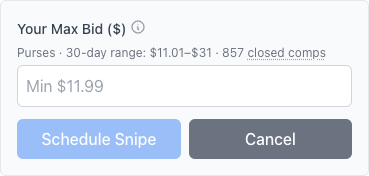
Purses · 30-day range: $11.01–$31 · 857 closed comps
That means finished auctions in Purses, over roughly the last 30 days, usually landed between $11 and $31. Closed comps is the count of those finished sales. Hover the words for the definition: a finished auction with a real final price. Wins, losses, and outbids all count; live, cancelled, and demo auctions don’t.
A caution, when there are plenty of sales but prices are all over the map:
Closes in this category vary widely. Base your max on this item, not the average.
Use what’s in front of you: condition, brand, photos, shipping. Don’t chase a fake middle number.
And nothing extra, when there isn’t enough to say. Set your max the way you do today.
(The small ⓘ next to Your Max Bid is still the old help about what a max bid is. It’s not this new line.)
Why it helps
A last-second bid only wins if your ceiling clears the other people who want the lot.
If similar purses keep selling between $11 and $31, an $8 max was never in that market. You didn’t “almost win”, you sat out the price fight entirely. Seeing the range before you snipe lets you add a little room on purpose, or skip the listing and keep your money.
If the category’s a grab-bag, we say so, so you don’t copy an average that doesn’t apply to this necklace. And if we don’t know, we don’t invent a number. Silence is the honest answer.
Pair the range with a max you can actually live with, shipping included. The free Max Bid Calculator is still where you check whether a higher ceiling makes sense. Timing doesn’t change: BidPulse still bids in the last seconds, and you still choose the ceiling.
What this isn’t
It won’t guarantee more wins. Other shoppers can still want the item more than you do.
It isn’t BidPulse spending extra dollars on your behalf.
And it’s never “the same item sold last month for $22.” It’s the category’s recent sold prices, shown only when that story is honest.
For how close these losses already were before this line existed, read We studied 622 outbids. For where snipes win most often, see ShopGoodwill win rates by category. If you want that max placed for you at the end, see how BidPulse works or pick a plan.